
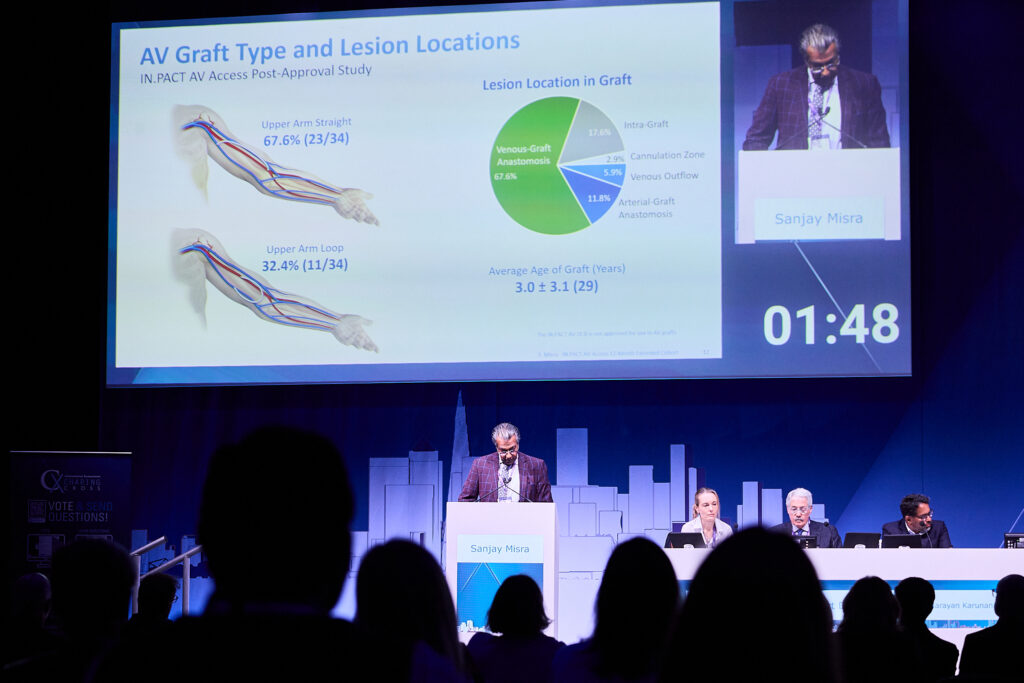
Extended cohort outcomes from the IN.PACT arteriovenous (AV) access postmarket study were “clinically reasonable and consistent with prior experience”, the 2026 Charing Cross (CX) Symposium (21–23 April, London, UK) heard in a Vascular Access Masterclass session focused on AV fistula stenosis. These data “reflect greater lesion heterogeneity and small sample sizes and should be interpreted cautiously”, presenter Sanjay Misra (Rochester, USA) told the audience.
The prospective, multicentre, singlearm, US Food and Drug administration (FDA)-mandated study involved patients treated with IN.PACT AV drug-coated balloon (DCB; Medtronic) for AV circuit stenosis.
Results from the extended cohort were being presented for the first time, following the first reveal of the 186-patient primary cohort of AV fistula patients at the 2026 Society of Interventional Radiology (SIR) annual scientific meeting (11–15 April, Toronto, Canada). The group included a broader pool of patients, including both AV fistulas and grafts. Baseline characteristics were typical of the end-stage kidney population, though, “of note, there were more female Black patients in the AV graft group in the extended cohort due to one site enrolling the majority of the patients”.
The mandated primary endpoint—serious infection rate at 12 months—performance goal of 30% was met. Among the 99 patients in the extended group, Misra reported the infection rate was higher in those with AV grafts and “favourable compared to prior literature”.
“Twelve-month survival data was in line with what we would expect from the end-stage kidney disease [ESKD] population,” he said. “Twelve-month primary patency was 70.2% in the AV fistula primary cohort, and 57.3% in the extended cohort. These rates are favourable compared to literature benchmarks of 50% for DCB and 37% for uncoated balloons in meta-analysis data.
“Not surprisingly, the patency rate was lower in the more complex AV graft cohort at 47%, but still favourable compared to prior randomised trials, with patency rates ranging from 23-–25% in the AV graft population. So, overall, the patency rates were clinically reasonable and consistent with prior experience. AV access primary patency and TLR [target lesion revascularisation] rates were also reasonable, again with respect to the worst rates in the more complex extended fistula and AV grafts cohorts.”
Extended cohort outcomes “reflect greater lesion heterogeneity and small sample sizes and should be interpreted cautiously,” Misra added. “Overall, real-world outcomes were consistent with expectations, with acceptable patency and no safety concerns.”